Two teams can order the same bowling shirt, spend a similar amount, and end the season with wildly different results. One set still looks sharp after a year of Thursday nights; the other has cracked lettering and a logo that has gone soft around the edges. The difference usually is not the shirt. It is the decoration method, and it is the one decision most captains make last when it deserves to be made first. The three methods you will actually be quoted on are screen printing, embroidery, and dye sublimation. Each has a shape of cost, a look, and a failure mode. Knowing them before you request a quote is what keeps a team order from becoming a season-long regret.
How the three methods actually work
Screen printing pushes ink through a fine mesh stencil, one screen per color, and cures it onto the fabric surface at roughly 320°F for plastisol inks. It lays down bold, opaque graphics and it is the default for cotton. Embroidery stitches the design in thread rather than printing it, which produces a raised, textured, premium look that reads well on the left chest of a heavier shirt, a polo, or a jacket. Sublimation turns solid dye into gas under heat and bonds it into the fibers of a polyester garment, so the design becomes part of the fabric instead of a layer sitting on top. That single physical difference explains most of what follows: printing and stitching add something to the surface, while sublimation changes the fabric itself, which is why it can only be done on polyester and works best on white or light shirts.
What each method costs, and why quantity changes the answer
Decoration pricing has two parts: a one-time setup and a per-shirt charge. Screen printing carries a setup fee of roughly $20 to $75 per screen, and because you need one screen per color, a three-color front can mean $75 to $150 in setup before a single shirt is printed. Embroidery replaces that with a one-time digitizing fee, generally $40 to $150, to convert your artwork into a stitch file that is then reused free on every reorder. Sublimation has the lightest setup, often $10 to $30 for file preparation.
The per-shirt cost is where order size decides the winner. Screen printing is expensive in small runs and cheap in large ones: expect roughly $15 to $25 per shirt in decoration for a dozen, dropping toward $6 to $10 at 72 to 143 pieces and $3 to $6 once you clear a few hundred. Embroidery stays flatter, commonly $3 to $8 per piece for a modest left-chest logo, rising with stitch count; a dense back design of 10,000 to 15,000 stitches can run $10 to $18. Sublimation sits in the middle at about $6 to $12 per item with only a small volume discount, because there is no cheap-at-scale screen to amortize. The chart below shows indicative midpoints across common quantity tiers so you can see where the lines cross.
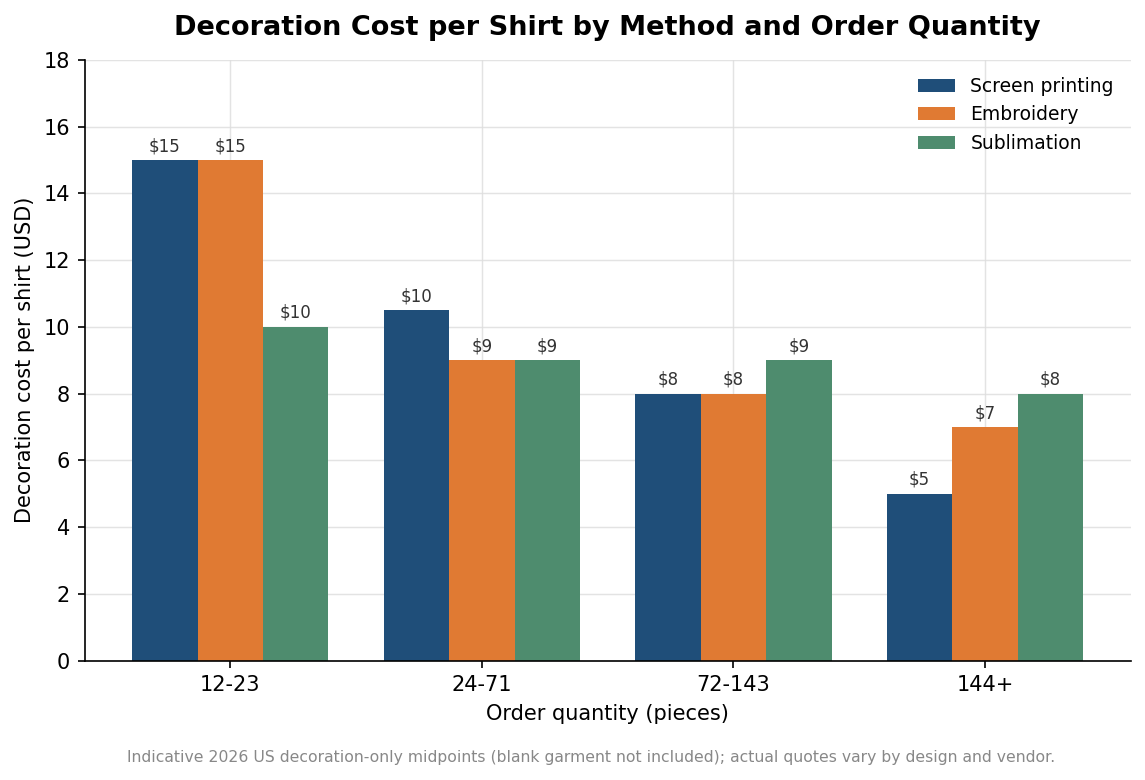
The practical read: for a single league team of 8 to 16 shirts with a simple design, embroidery or sublimation is often competitive because screen setup is spread over too few shirts. Once you are outfitting a whole house league or a tournament of 72 shirts or more with a bold multi-color graphic, screen printing pulls decisively ahead on price per piece. These are decoration figures only; the blank garment is separate, and any real quote will move with your specific artwork and vendor.
Durability: which one survives a full season
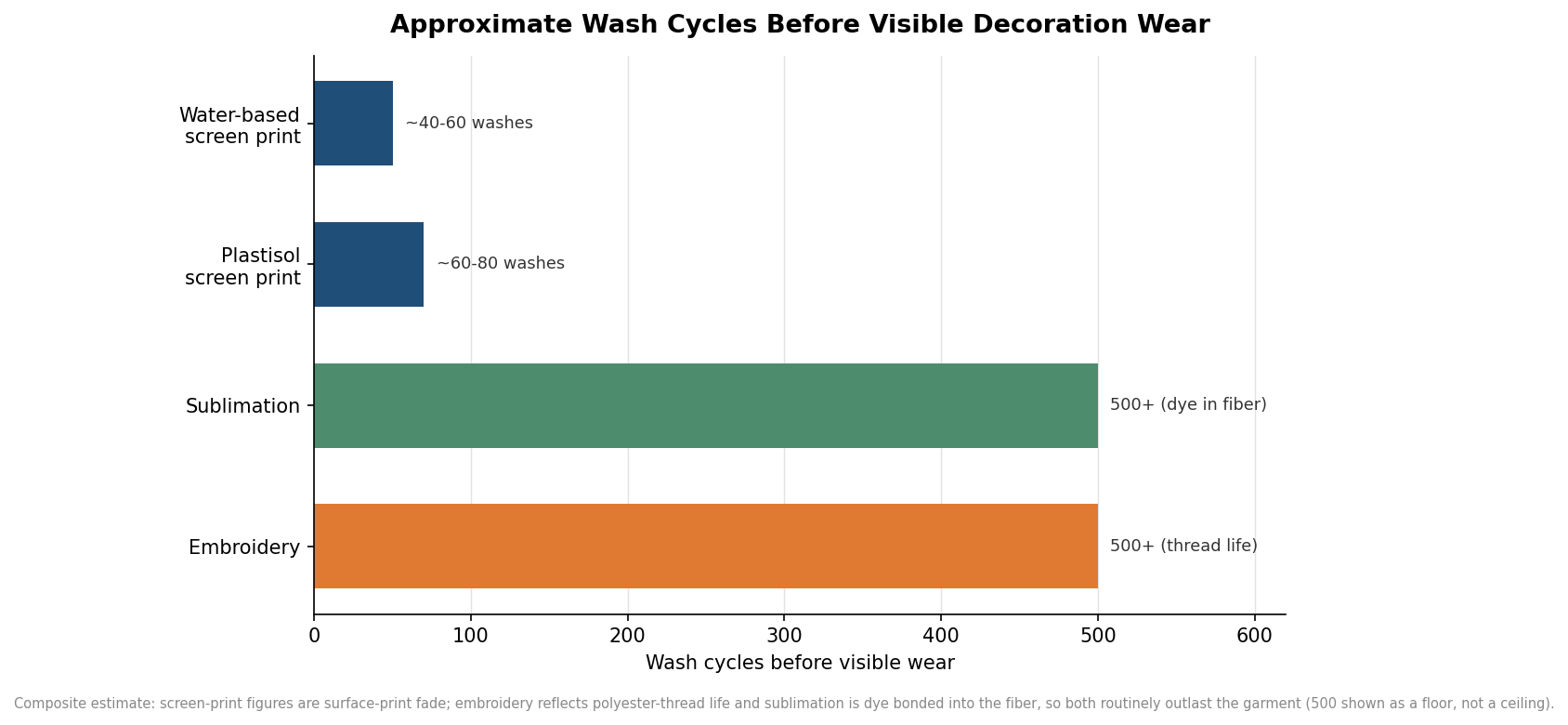
Bowling shirts get worn hard and washed often, so longevity matters more than for a giveaway tee. Screen printing is durable but not permanent: plastisol prints typically hold up for about 60 to 80 wash cycles before visible cracking or fading, and water-based inks somewhat less, around 40 to 60. That is fine for a season or two of regular wear. Embroidery is in a different class because polyester thread does not crack or fade the way surface ink does; a stitched logo routinely outlasts the garment it sits on. Sublimation shares that advantage for a different reason, the dye is bonded into the fiber with no surface layer to peel, so the graphic effectively lasts as long as the shirt. The comparison below is a composite, since screen-print numbers measure surface-print fade while the embroidery and sublimation figures reflect thread life and in-fiber dye, but the ranking it shows is real.
Color, detail, and the design you can actually reproduce
Your artwork may quietly rule out a method before cost ever enters the picture. Screen printing handles bold spot colors efficiently, usually one to eight, with each additional color adding both a screen and roughly $0.50 to $2.00 per piece, so a photographic gradient is a poor fit. It does hold fine detail well, down to text around 4pt. Embroidery is the opposite: colors are effectively free once the logo is digitized, drawing from palettes of 400-plus thread colors, but thread cannot render tiny type or thin lines, so keep lettering at roughly 14pt or larger and avoid hairline strokes. Sublimation is the only one of the three that reproduces unlimited full-color, photographic artwork edge to edge, including all-over prints that wrap the shirt, which is why splashy tournament and novelty designs so often use it, again with the polyester-and-light-colors constraint.
Matching the method to the garment
The shirt underneath should drive the decision as much as the design on top. A classic cotton camp-collar bowling shirt or a cotton tee such as a Gildan 5000, offered in a full size range from XS through 5XL, pairs naturally with screen printing. A heavier polo or jacket, where a raised left-chest mark looks its best, is embroidery territory. A modern performance jersey in moisture-wicking polyester, the kind of athletic-cut shirt many competitive keglers now prefer, is the natural home for sublimation because the dye needs polyester to bond to and the process adds no heavy ink layer to trap sweat. If you want the sharp look of a full-color performance jersey, do not order it in cotton and then ask for sublimation; the fabric decides what is possible.
On lead time, plan for roughly 7 to 10 business days for screen printing and 7 to 14 for embroidery, longer for very dense stitch counts, and confirm before a league night or tournament deadline rather than after. Where a figure here is given as a range, treat it as indicative; the point is to walk into your quote knowing which method your quantity, design, and fabric already point to, so the shirt your team wears in week one still looks like a team in week twenty.